Science
Related: About this forumNASA Fires Up Powerful Lithium-Fed Thruster for Trips to Mars
Pardon me if this has already been posted:
https://www.jpl.nasa.gov/news/nasa-fires-up-powerful-lithium-fed-thruster-for-trips-to-mars/
April 28, 2026
?si=JllJr6Q2Sppvkt51
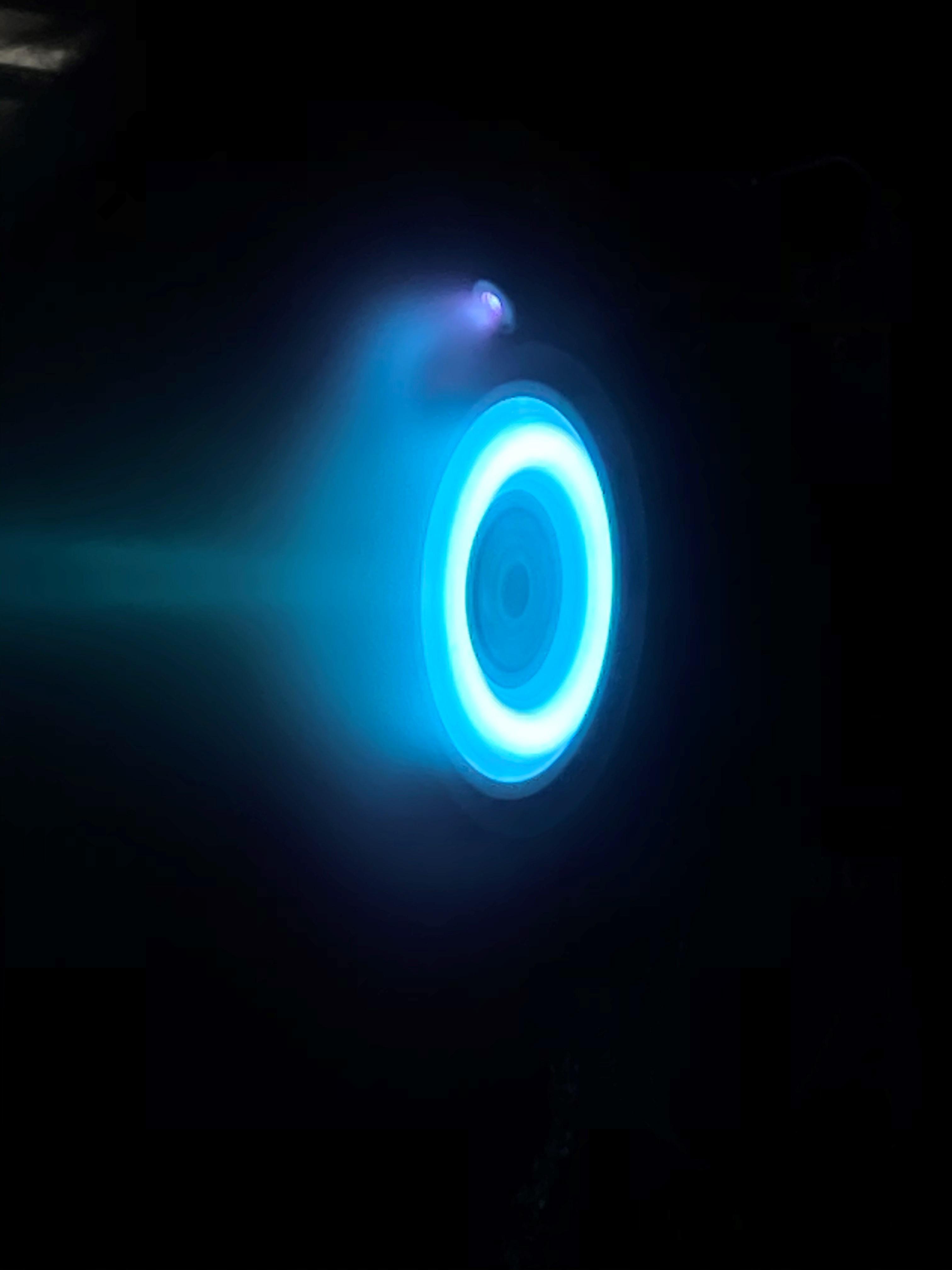
A prototype of a lithium-fed magnetoplasmadynamic thruster was tested in a special chamber at NASA’s Jet Propulsion Laboratory in February 2026. With further development, thrusters like this could be part of a nuclear electric propulsion system powering human missions to Mars. Credit: NASA/JPL-Caltech
A novel electromagnetic thruster passed an initial test in a specialized chamber at JPL. With further development, these thrusters could support human missions to the Red Planet.
A technology that could propel crewed missions to Mars and robotic spacecraft throughout the solar system was recently put to the test at NASA’s Jet Propulsion Laboratory in Southern California. On Feb. 24, for the first time in years and at power levels exceeding any previous test in the United States, a team fired up an electromagnetic thruster that runs on lithium metal vapor.
This prototype achieved power levels beyond the highest-power electric thrusters on any of the agency’s current spacecraft. Valuable data from the first firing of this thruster will help inform an upcoming series of tests.
“At NASA, we work on many things at once, and we haven’t lost sight of Mars. The successful performance of our thruster in this test demonstrates real progress toward sending an American astronaut to set foot on the Red Planet,” said NASA Administrator Jared Isaacman. “This marks the first time in the United States that an electric propulsion system has operated at power levels this high, reaching up to 120 kilowatts. We will continue to make strategic investments that will propel that next giant leap.”
During five ignitions, the tungsten electrode at the thruster’s center glowed bright white, reaching over 5,000 degrees Fahrenheit (2,800 degrees Celsius). The work was conducted in JPL’s Electric Propulsion Lab, home to the condensable metal propellant vacuum facility, a unique national asset for safely testing electric thrusters that use metal vapor propellants at up to megawatt-class power levels.
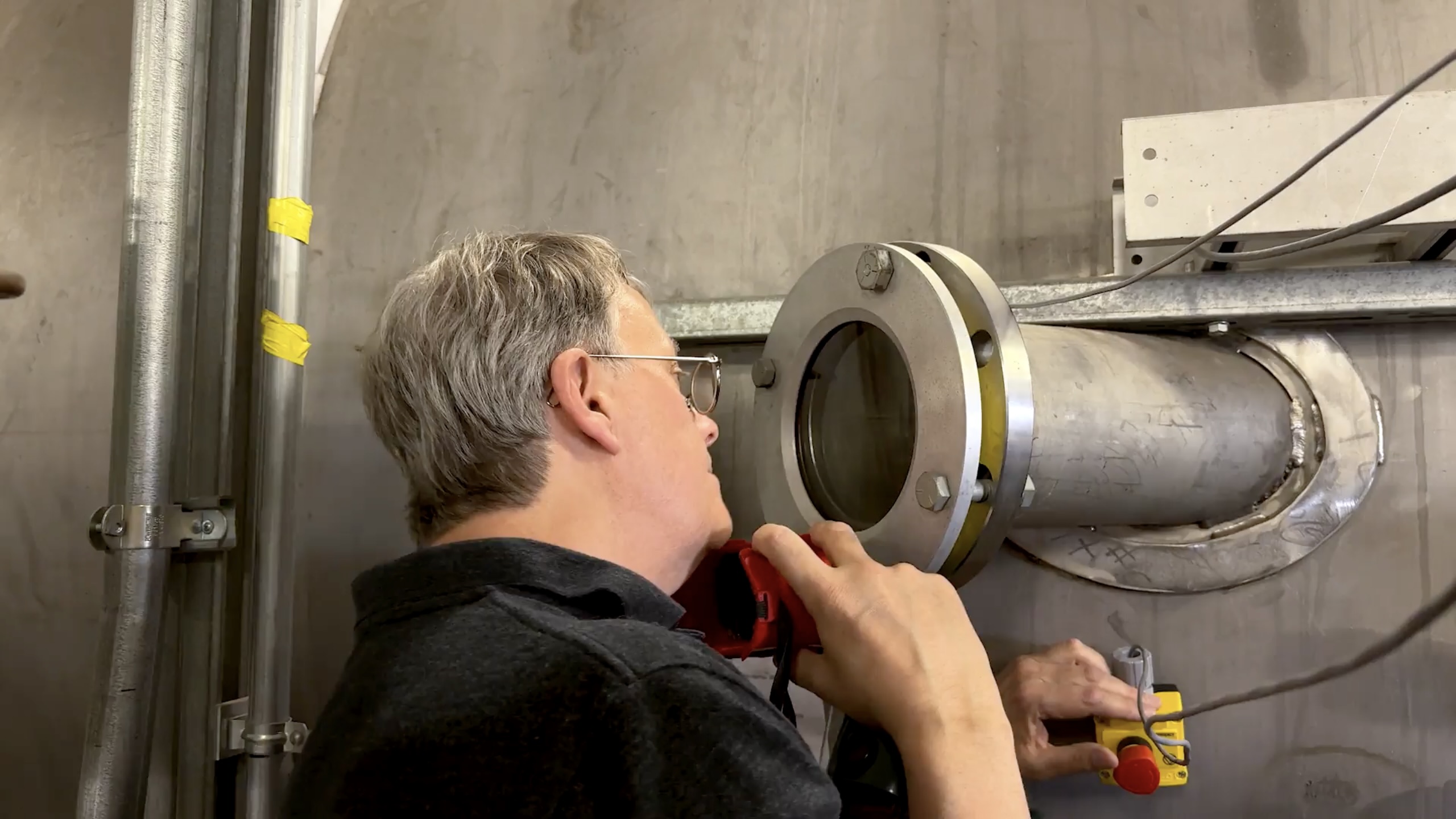
JPL senior research scientist James Polk peers into the condensable metal propellant (CoMeT) vacuum facility at JPL’s Electric Propulsion Lab, where a high-power electric thruster prototype his team developed was being put to the test in February 2026. Credit: NASA/JPL-Caltech
Powering up
Electric propulsion uses up to 90% less propellant than traditional, high-thrust chemical rockets. Current electric propulsion thrusters, like those powering NASA’s Psyche mission, use solar power to accelerate propellants, producing a low, continuous thrust that reaches high speeds over time. NASA JPL is testing a lithium-fed magnetoplasmadynamic (MPD) thruster, a technology that has been researched since the 1960s but never flown operationally. The MPD engine differs from existing thrusters by using high currents interacting with a magnetic field to electromagnetically accelerate lithium plasma.
During the test, the team achieved power levels of up to 120 kilowatts. That’s over 25 times the power of the thrusters on Psyche, which is currently operating the highest-power electric thrusters of any NASA spacecraft. In the vacuum of space, the gentle but steady force Psyche’s thrusters provide over time accelerates the spacecraft to 124,000 mph.
…
 = new reply since forum marked as read
Highlight:
NoneDon't highlight anything
5 newestHighlight 5 most recent replies
= new reply since forum marked as read
Highlight:
NoneDon't highlight anything
5 newestHighlight 5 most recent replies

3Hotdogs
(15,537 posts)
eppur_se_muova
(42,474 posts)more efficiency. This engine uses lithium, the third lightest atom known, so the operating principles must benefit from light atoms in this technology. Smaller atoms are faster-moving at the same temperature compared to heavier atoms, and faster-moving ions would create larger currents and larger magnetic fields. Would be nice to see the math breakdown on this.
If that's correct, use of Li-6 enriched fuel could give a significant performance boost over natural isotopic abundance lithium. DOE currently separates lithium isotopes on a huge scale to use Li-6 in hydrogen bombs. Surely we could spare some that to power a space probe, thereby increasing its acceleration and chances of mission success.
(The IUPAC reports the gradual slow increase in the atomic weight of commercial lithium as the lighter isotope, Li-6, is withdrawn from circulation.)
https://en.wikipedia.org/wiki/Lithium

OKIsItJustMe
(22,087 posts)https://www1.grc.nasa.gov/wp-content/uploads/NERVA-Nuclear-Rocket-Program-1965.pdf
❝With nuclear rockets man will have the capability of much longer range space exploration) because of their inherent superiority over chemical rockets. The NERVA program has demonstrated the feasibility of such nuclear rockets.❞
https://en.wikipedia.org/wiki/Nuclear_thermal_rocket
This thruster is similar to the ones used by Discovery in 2001.

https://ntrs.nasa.gov/api/citations/20070032050/downloads/20070032050.pdf
❝…Propellants of choice for MPD thrusters are hydrogen and lithium, because of their low atomic mass and relatively low ionization energies (Ageyev, 1993 and Lapointe, 2002). Lithium’s very low first ionization energy makes it particularly advantageous at lower powers (0.5 – 5 MW) and moderate exhaust velocities (20-70 km/s). Hydrogen is more amenable to multimegawatt and high specific impulse operations, is easier to supply to the thruster as a gas, and is less likely to condense on spacecraft surfaces.❞
eppur_se_muova
(42,474 posts)In contrast, ionized gases/plasmas interact with both electric and magnetic fields to produce that equal-and-opposite thrust. The electrostatic ion engine seems to be favored by high mass/charge ratio -- high m, low v means a lower delta-mv for the same delta-m(v-squared), I guess. Thrust is controlled by the electric field, whereas the classic rocket equation relies only on thermal energy (from combustion, or nuclear reactor) to give gas molecules velocity. I'm assuming MPD (a variation on MHD, presumably) creates large magnetic fields through discharges in the conducting plasma, but I'm really guessing there -- I'd really like to see a basic-math treatment of both.
OKIsItJustMe
(22,087 posts)Last edited Sat May 16, 2026, 02:23 PM - Edit history (2)
As well as this one linked to in the OP. https://alfven.princeton.edu/publications/pdf/polk-iepc-2024.pdf
I gave you the wrong impression by citing the NERVA engine, which, as you say, used a nuclear reactor to heat hydrogen which was then used as a propellant. My (unclear) point was that nuclear-powered engines have been being researched by NASA (and its predecessors) since the mid-50’s.
In the case of the “MPD thruster,” the hydrogen is being used as a plasma.
https://en.wikipedia.org/wiki/Magnetoplasmadynamic_thruster
Psyche uses xenon gas in its ion thrusters.
I read once that Gene Roddenberry rejected the use of ion thrusters for the Enterprise because they were too slow. (In the original series, they occasionally encountered more primitive spaceships which used them — as I recall Khan’s Botany Bay used ion thrusters.)
eppur_se_muova
(42,474 posts)Project Orion has been discussed in many books about the history of the atomic bomb, bios of famous physicists involved in the Manhattan Project, space travel, etc. If you'll search old posts in DU you'll find references to the AF's mockup nuclear-powered bomber and nuclear-H2 engines (mostly about the history of these discontinued projects).
One of the odder ideas was to coat a pusher plate with Cf-254, which decomposes mostly by spontaneous fission. The ejected nuclei would be the reaction mass, and since they travel at marginally-relativistic velocities, the potential terminal velocity would be tremendous. The problem, of course, would be in handling such a huge amount of Cf-254.

OKIsItJustMe
(22,087 posts)Orion was a proposal to use a series of nuclear explosions to power a spacecraft (a silly/insane idea IMHO, but one which keeps coming back!)
NERVA simply used a nuclear reactor as a heat source, instead of burning the fuel to provide the heat to expand the gases for propulsion. I don’t believe it would have been able to lift a spacecraft into orbit, however, it was considered for use on the upper stage(s) of the Saturn V.
eppur_se_muova
(42,474 posts)OKIsItJustMe
(22,087 posts)I just didn’t want the casual reader confusing the two. While both projects (NERVA and Orion) started at (roughly) the same time, Orion was absurd, and NERVA (much more) practical. NERVA-style engines were built and tested.
https://www.nasa.gov/rocket-systems-area-nuclear-rockets/
I keep imagining astronauts sitting atop a rocket being thrust into space by a series of powerful explosions, the ride was quite rough enough on conventional engines. (Presumably, they would have had some immense "shock absorbers” to cushion them from the blasts… The structural metal required to hold the rocket together would have added so much mass…)
They might as well have fired them from a giant cannon!
eppur_se_muova
(42,474 posts)I hope not too many DUers need to be told that riding a series of nuclear explosions to the stars was an absurd idea -- it's just one of those things that someone was bound to think of at the time.
OKIsItJustMe
(22,087 posts)In their alternate timeline, they deploy a number of things NASA had on the drawing boards, but never used, including a nuclear powered engine. I mentioned this to a space/scientifically literate friend, and he immediately thought I meant using explosions to power a spacecraft.
In fact, it was while looking for documentation on the NERVA project that I “stumbled” upon the story in the OP.

erronis
(24,496 posts)How much would be needed to power a manned space trip to Mars - and return?

3825-87867
(2,016 posts)techs are waiting for the next unscheduled disassembly.
But NASA is old and whatever...
OKIsItJustMe
(22,087 posts)Written by Asa Stahl, PhD
Science Editor, The Planetary Society
April 13, 2026
Only days after NASA launched astronauts to the Moon for the first time in decades, the White House’s budgeting office announced a plan to reduce NASA’s workforce by thousands and cancel over 50 NASA missions. If enacted, the proposal would slash the agency’s science program by a devastating 46% and turn off spacecraft already paid for, launched, and making discoveries. Instead of celebrating Artemis II’s historic accomplishment, this proposal dismantles NASA as the agency works to bring its crew back home.
The White House Office of Management and Budget proposed similar budget cuts last year, and The Planetary Society helped people around the world raise their voices in support of NASA science. Just a few months ago, Congress rejected the budget cuts and funded NASA in full.
Now the threat has returned, and we are again organizing the Save NASA Science campaign to show our elected officials that space science and exploration matter.
The first step is knowing what’s at stake. Here are some of the many missions slated for cancellation, and the mysteries that would go unsolved if we turned our backs on them.
…
https://www.theguardian.com/science/2026/apr/11/artemis-ii-nasa-budget-cuts
Even as a triumphant moon flyby primes agency for a 2028 landing, Trump’s proposed budget cuts cast pall on US space program
Richard Luscombe
Sat 11 Apr 2026 08.33 EDT
…
Even as Integrity, the mission moniker for the Orion capsule of Artemis II, ascended into the heavens days ago, Donald Trump was announcing his intention to slash Nasa’s budget by 23%, including a 46% cut for space science initiatives. And the Artemis program that has run years behind schedule and billions of dollars over budget offers no guarantees that the next, far harder stages will run as smoothly.
…
Isaacman said he supported the White House desire to strip a further $6bn in funding from his agency, insisting that the levels “are sufficient” to meet “high expectations and deliver on all mission priorities”.
But Casey Dreier, chief of space policy at the Planetary Society, said Isaacman’s argument made no sense.
“The administrator is part of the administration, and the budget document is an official policy statement of the administration, so he has to be onboard,” he said.
…
eppur_se_muova
(42,474 posts)TSF = b*J^2 {the rest of the formula involves only the engine dimensions}
where {T-sub-SF is thrust, J is total current, and} μ0 is the permittivity of free space, ra is the anode radius, and rc is the cathode radius. Unlike other thruster types, the electromagnetic thrust is independent of the flow rate (dm/dt) and propellant properties{!!!}. The specific impulse is given by
Isp = b*J^2/(dm/dt) .
***
The useful work in an MPD thruster is that done by the Lorentz force, and the thruster efficiency is determined by the magnitude of the thrust power compared to loss mechanisms such as frozen flow losses and power dissipated at the electrodes. The efficiency with inert gas propellants is generally low, not exceeding 20-30%. With hydrogen the efficiency can exceed 50% at over 10000s and very high power levels (over 10 MWe per engine). Lithium appears to be the best option for powers up to several MWe per engine and more moderate Isp, having demonstrated 50-60% efficiency at 4000-5000 s. This is in part because of low frozen flow losses. The first ionization potential ... {see OKIIJM's post for the rest}
https://alfven.princeton.edu/publications/pdf/polk-iepc-2024.pdf
So my remarks about low MW of the exhaust atoms -- so important in chemical rockets -- were barking up the wrong tree. The use of high MW ejecta in electrostatic ion drives is particular to that particular mode of propulsion. MPD/MHD is all magnetism*, baby, and the equations reflect that -- they are profoundly different from the derivation of SI for chemical rockets. So no need to look for low or high MW (bye-bye Li-6, which seemed like a neat tweak), and other factors dominate the choice of propellant.
It must have been a real pleasure to work out the mathematics of MPD for the first time and realize that by a truly remarkable cancellation of terms, suddenly MW didn't matter -- nor did mass flow ! It would have been such an astonishing result -- almost an apostasy -- that it looked like it was more likely to be a mistake. As the equations above show, once a particular MPD engine is designed, varying thrust is as simple as varying current. Turn a knob, get more acceleration. And with the advantages of lithium spelled out, it's hard to see how anything better is likely to be found -- but then, it's not obvious why Li is a better choice at some energies and H2 better at others -- all the advantages of a Li+/e- plasma seem to apply to an H+/e- plasma as well. It seems to be a matter of some fairly subtle tweaks -- just the thing to be worked out by dogged engineering, not just shopping the Periodic Table.
*

OKIsItJustMe
(22,087 posts)Yeah, I imagine someone saying to a trusted colleague, “Check me on this please."