Anthropology
Related: About this forum"Seeking the Koko' Ta'ay"--Taiwan's Little People, Big Questions
by Massimo Introvigne | Dec 3, 2025 | Featured China
A book suggests that legends about vanished short-statured beings may have a kernel of truth—and challenge the Han-centered narrative of the history of China.
by Massimo Introvigne
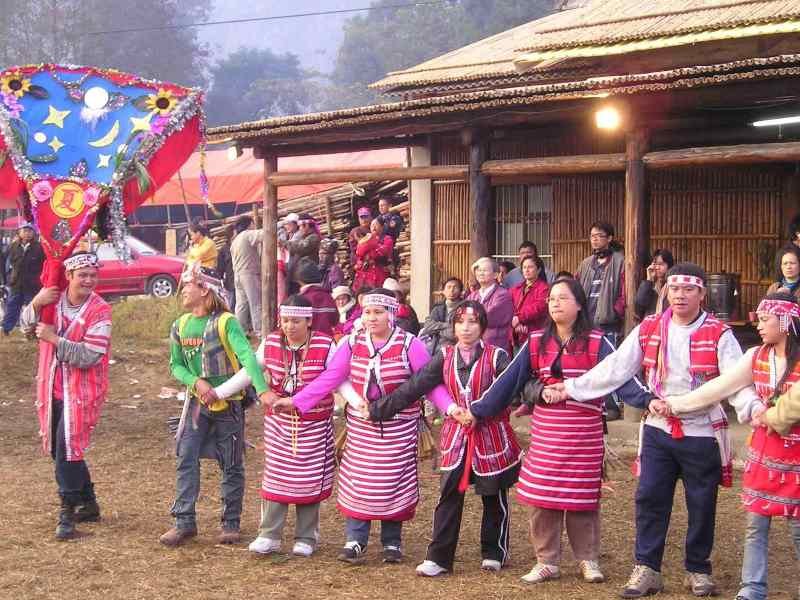
PaSta’ay festival in Miaoli, Taiwan. Credits.
In “Seeking the Koko’ Ta’ay: Investigating the Origins of Little People Myths in Taiwan and Beyond” (Leiden: Brill, 2024), editors Tobie Openshaw and Dean Karalekas have assembled a scholarly constellation that glows with myth, memory, and political defiance. The book is a multidisciplinary inquiry into the recurring legends of short-statured beings—known among the Saisiyat as ta’ay—who once lived in Taiwan, China, and across the Austronesian world. But this is no mere folklore compendium. It’s a challenge to nationalist historiography, a celebration of Indigenous epistemologies, and a subtle act of resistance against the Han-centric narrative of Chinese antiquity.
The book invites readers to treat myths as maps, tracing the contours of cultural memory across Taiwan, China, and the Pacific. The authors argue that the legends of the ta’ay and their counterparts—the veli of Fiji, the MKsingut of Atayal lore, and the misinsigots of Paiwan tradition—may encode real encounters with Negrito populations, the so-called “First Peoples” of the region. These myths, he suggests, are not quaint tales but mnemonic devices, preserving the memory of Paleolithic foragers who once roamed Taiwan’s grassy plains before it became an island—and parts of present-day Mainland China too.
This thesis is politically potent. If Negritos once inhabited Taiwan and parts of southern China, then the Han narrative of uninterrupted civilizational dominance is fractured. The book thus becomes a quiet torpedo aimed at Chinese propaganda, which often erases non-Han histories in favor of a monolithic past.
The book’s first section, “The Science,” includes Paul Jen-kuei Li’s linguistic survey of the myths. Li revisits his earlier work, noting the absence of linguistic evidence to confirm the ta’ay’s existence and the tantalizing possibility that recent archaeological finds, like the Xiaoma Lady, may change that. The Xiaoma Lady, discovered in a cave on Taiwan’s east coast, is a 6,000-year-old skeleton with cranial features and stature reminiscent of Negrito populations.
More:
https://bitterwinter.org/seeking-the-koko-taay-taiwans-little-people-big-questions/
 = new reply since forum marked as read
Highlight:
NoneDon't highlight anything
5 newestHighlight 5 most recent replies
= new reply since forum marked as read
Highlight:
NoneDon't highlight anything
5 newestHighlight 5 most recent replies

Judi Lynn
(164,183 posts)A combination of ancient knowledge and modern research techniques may be closing the gap between who some of the earliest people to settle in Taiwan could have been and its current residents. The key to the earliest chapters of Taiwan’s history may lie in the stories and traditions of groups like the Saisiyat Indigenous people.

February 3, 2025
Updated on Jan 31, 2025
By Ashish Valentine
Members of the Indigenous Saisiyat community perform a series of 16 songs alongside ritual dances, representing the knowledge that the Koko Ta’ay gave to their ancestors a long time ago.
Ashish Valentine/The World
Indigenous knowledge, along with the newest discoveries, could peel back the story of some of the earliest humans to settle in present-day Taiwan.
It wasn’t until around 400 years ago that the first Chinese settlers arrived — just a few years after the Mayflower landed at Plymouth Rock in Massachusetts.
Before that, Taiwan was home to Indigenous Austronesian peoples. Over time, some sailed away, settling in other parts of Southeast Asia or even as far away as Madagascar, New Zealand and Hawaii. Others have remained to this day — and now makeup 16 officially recognized Indigenous groups in Taiwan.
One of those groups, the Saisiyat, is known throughout Taiwan for maintaining an ancient spiritual connection through stories and rituals passed down over countless generations. That connection and new scientific discoveries may help unravel a mysterious chapter of Taiwan’s past.
More:
https://theworld.org/stories/2025/02/03/new-discoveries-shed-light-on-some-of-the-earliest-humans-to-settle-in-taiwan